






Ayodhya 14 Kosi Parikrama Draws Lakhs as Drones, CCTV and 10 Security Zones Guard the Route
The Ayodhya 14 Kosi Parikrama is under way in the temple town, with lakhs of devotees walking the sacred circuit around the city since the early hours of Wednesday. The auspicious time for the ritual circumambulation began at 1:21 am on the night between Tuesday and Wednesday, coinciding with Akshay Navami, but a large number of pilgrims did not wait for the muhurat and set off on the route well before it, according to the district administration.
Officials expect close to 20 lakh people to take part in the walk this year, a turnout that senior police officers in Ayodhya describe as noticeably larger than usual. Devotees have been arriving in the city since Monday, with many staying in ashrams and dharamshalas and visiting nearby religious and historical sites before beginning the parikrama.
A 45-km walk of faith around Ayodhya
The 14-kos circuit stretches for roughly 45 kilometres around Ayodhya and is traditionally completed on foot, often barefoot, by devotees chanting hymns and the name of Lord Ram. Saints, families from rural Uttar Pradesh and groups from neighbouring states could be seen moving in long columns along the route from the early morning, with the chant of “Jai Shri Ram” echoing at several points. After completing the circuit, a large number of pilgrims take a holy dip in the Saryu river, which is considered an essential part of the ritual.
The Ayodhya 14 Kosi Parikrama is linked with the Kartik month and the Gopashtami and Akshay Navami traditions, which is one reason the crowd is particularly heavy this week. It is followed by the shorter 5-kosi parikrama, scheduled for November 19 and 20, and later by the Kartik Purnima mela, which officials say will be held around November 23.
Ten zones, six drones and teams on the Saryu
To manage a crowd of this size, the administration has divided the entire parikrama route into 10 zones, each with its own officers. Police personnel have been posted at major halts, sensitive spots and sharp turns on the circuit. CCTV cameras have been installed across the mela area and a control room is monitoring the feeds round the clock.
Six drones are keeping a watch on crowd movement from the air, four regular units and two tethered drones that can stay aloft for long periods over fixed points. On the river side, teams of water police, flood PAC and the State Disaster Response Force have been deployed along the Saryu and other water bodies, where the risk of accidents rises when lakhs of people bathe within a few hours.
The DIG of the range said multi-layer security arrangements had been made because of the unusually high footfall, and that the route itself had been organised so that people could move in and out smoothly. The ADG of the Lucknow zone said the police were working in coordination with local community figures to keep the event safe and comfortable for pilgrims.
Traffic diversions on Ram Path and highways
The Ayodhya SSP said a special traffic and parking plan had been drawn up for devotees coming from distant districts. Separate parking areas have been marked for two-wheelers, cars and heavy vehicles so that roads close to the circuit remain free for walkers.
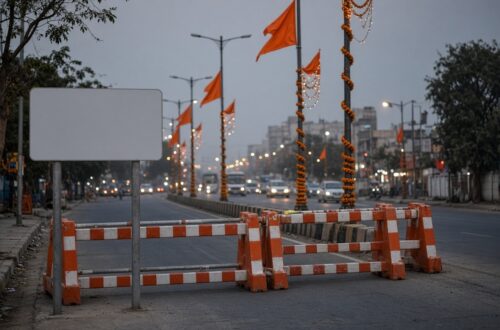
Motor vehicles have been barred on Ram Path, the main road that links the Ram Temple with the Lucknow-Ayodhya national highway, and visitors on the highway are not being allowed to turn towards the city from the Sahadatganj intersection. Traffic on the Lucknow-Ayodhya-Gorakhpur highway is also being diverted, with vehicles heading from Lucknow to eastern Uttar Pradesh being sent via the Purvanchal Expressway, while the Lucknow-Barabanki highway and routes via Ramnagar and Ghaghra Ghat are being suggested as alternatives. Officials have indicated that these restrictions may stay in place until Saturday afternoon or evening, once the rituals are complete.
Cleanliness and temple queues in focus
District Magistrate Shashank Tripathi said pilgrims had begun arriving well before the muhurat and that the administration had prepared for the early rush. The Ayodhya municipal corporation has deployed sanitation staff across the city, with special attention to the ghats, where waste tends to pile up after mass bathing.
The Ram Temple trust has also reviewed its arrangements in anticipation of a heavy rush for darshan after the parikrama. It is considering raising the number of entry queues into the main temple complex from six to seven or eight, depending on the size of the crowd.
For Ayodhya, the challenge this week is twofold: allowing an ancient ritual of faith to proceed without disruption while keeping lakhs of walkers, bathers and vehicles moving safely through a city that has seen a steep rise in visitors since the Ram Temple opened. With the 5-kosi parikrama and the Kartik Purnima bathing still to come, the security and traffic arrangements are expected to remain in force for several more days.